
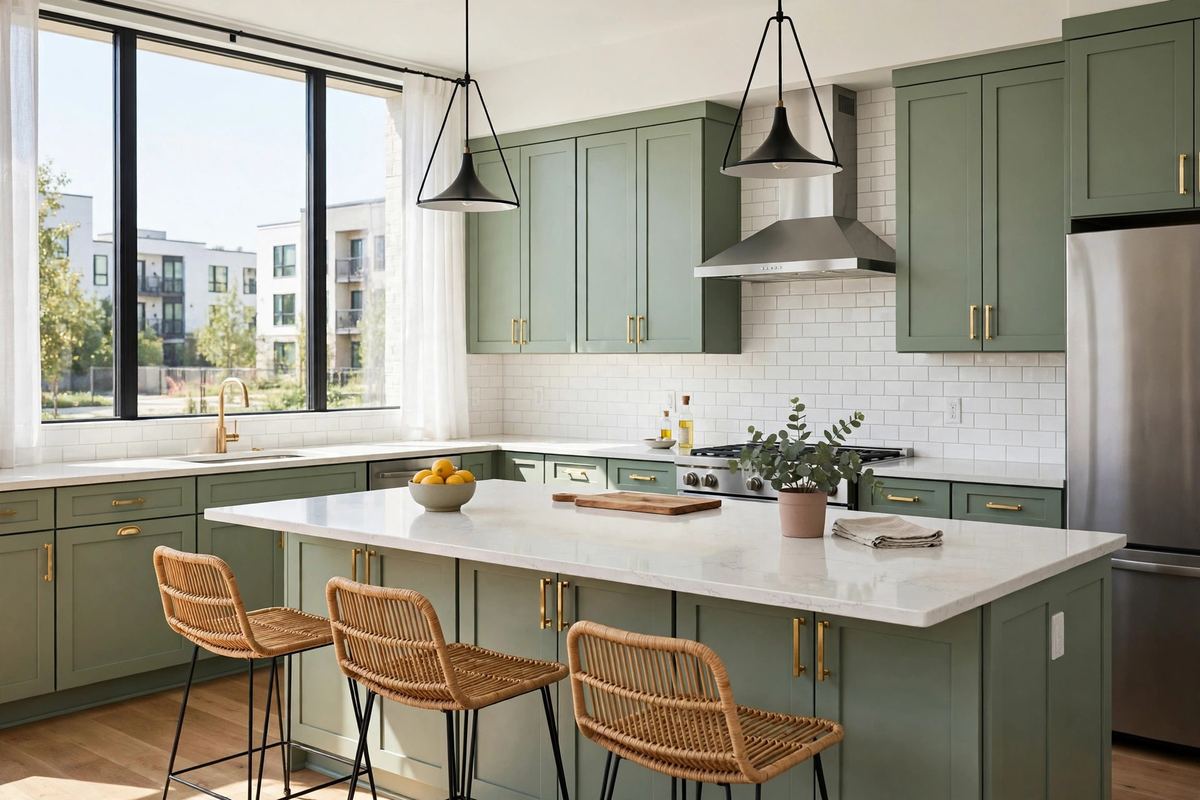
Ready-to-assemble (RTA) cabinets have moved from a budget workaround to a mainstream choice for U.S. multifamily projects. When hundreds of units need the same kitchen, the question is no longer whether RTA cabinets are good enough — it is whether they fit the project's schedule, labor plan and cost targets better than pre-assembled cabinets.
RTA cabinets ship flat-packed: panels, doors, drawers, hardware and fasteners in a compact carton, assembled on site or in a staging area. The cabinet itself is the same box a factory would assemble — the difference is where the final assembly happens, and who does it. For multifamily projects, the flat pack is the point. A container holds far more flat-packed cabinets than assembled ones, which cuts freight cost per unit and makes large orders practical. Thailand cabinets shipped as RTA also arrive with less transit damage, because flat panels pack tighter and brace better than hollow boxes.
A trained two-person crew assembles a standard base cabinet in 15–25 minutes, including doors and drawers. A full kitchen — ten to twelve cabinets — takes a crew about half a day. For a multifamily project, that assembly work is usually done in a staging area, several units ahead of the installers, so the install crew never waits for boxes. Quality depends on the hardware, not the concept. Cam-lock and dowel construction with metal corner brackets produces a cabinet as rigid as a factory-assembled box. Look for 3/4-inch panels, soft-close hinges and full-extension drawer slides — the same specifications you would demand from an assembled cabinet.
RTA cabinets typically cost 20–40% less than comparable assembled cabinets, and the savings come from three places: lower freight (more cabinets per container), lower factory labor, and less packaging waste. For a 200-unit project, that difference can fund the appliance package or the countertop upgrade. The savings are real only if assembly labor is planned. Budget the crew hours, the staging space and the small tools — drills, clamps, a level — and the total installed cost still beats assembled cabinets on most multifamily projects. The one exception is a project with a very tight install window and no staging area: then the speed of pre-assembled delivery may be worth the premium.
Flat-packed cabinets change the logistics of a multifamily project. A single container carries the cabinets for many units, deliveries can be staged by building or floor, and damaged parts are replaced as individual panels rather than whole cabinets — a door or a side panel ships in days instead of weeks. For developers phasing a project across months, RTA also makes reorders simple: the same cabinet program ships in the same cartons, so a later phase matches the first phase exactly, down to the finish and the hardware.
Freight cost: RTA wins — far more cabinets per container. On-site labor: Assembled wins — no assembly crew needed. Damage replacement: RTA wins — replace a panel, not a cabinet. Install speed: Assembled wins — boxes go straight on the wall. Total project cost: RTA usually wins on projects of 50 units or more. Finish consistency: A tie — both come from the same factory lines. Most multifamily developers choose a mix: RTA for the standard unit kitchens, where volume drives the savings, and assembled cabinets for model units and amenity spaces, where install speed matters most.
Ask your supplier for the assembly instructions, the hardware list and a sample cabinet before committing. Check that doors and drawers arrive pre-drilled, that the finish is applied before packing (not after assembly), and that spare parts — hinges, slides, shelf pins — are included in the order. A supplier that stocks spare parts is a supplier that understands multifamily timelines.
Are RTA cabinets durable enough for rental units? Yes, when they are built to multifamily specifications — 3/4-inch panels, cam-lock and dowel joints, metal brackets and soft-close hardware. The assembly method does not decide durability; the materials and hardware do.
How long does it take to assemble RTA cabinets for one unit? A trained two-person crew needs about half a day for a standard kitchen of ten to twelve cabinets. Staging the assembly a few units ahead of the installers keeps the project on schedule.
Do RTA cabinets really save money on a multifamily project? Usually, yes — 20–40% on the cabinet cost itself, plus lower freight per unit. The savings are largest on projects of 50 units or more, where assembly labor is spread across many kitchens.
What if a part arrives damaged? With RTA, only the damaged panel is replaced, and it ships as a flat part. That is faster and cheaper than replacing a whole assembled cabinet.
Can RTA cabinets, countertops and flooring come from one supplier? Yes. Dawson Stone and Cabinet supplies RTA cabinet in Malaysia and Thailand cabinets as one multifamily package, together with quartz and granite countertops and SPC flooring — produced by our Thailand plant in Nong Yai, Chon Buri, and our Malaysia cabinet factory in Muar, Johor.
Contact Dawson Stone and Cabinet — one-stop cabinets, countertops and flooring for U.S. multifamily projects. Email: info@thailandcabinetry.com · Phone: +1-657-615-8019 · WhatsApp: +86 130 5543 1394.

Equipo de diseño profesional, con más de 7 años de experiencia promedio en el diseño de viviendas para satisfacer las necesidades de diferentes clientes.


 IPv6 RED SOPORTADA
Links : :
W7 Ceramic Solutions
 en
 es


