
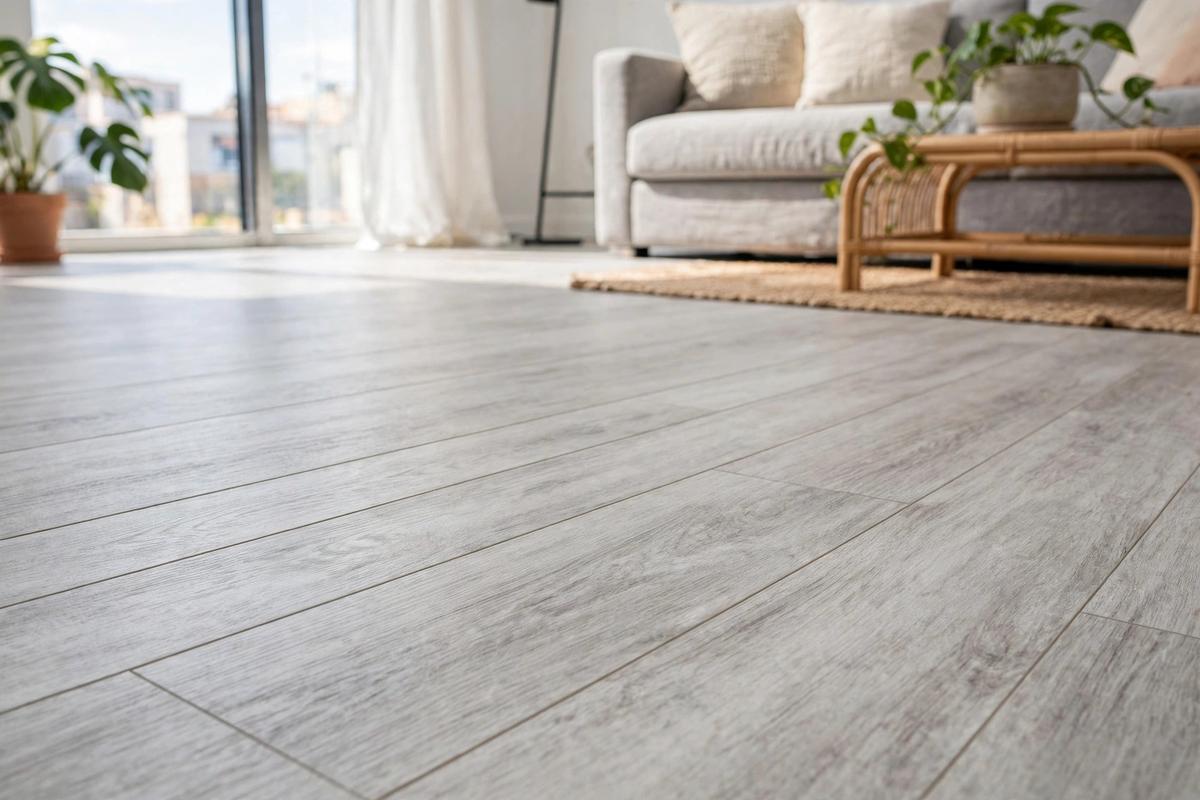
SPC flooring — stone plastic composite — has become the default hard-surface floor for U.S. multifamily projects. But two numbers on every specification sheet cause the most confusion: total thickness and wear layer. Getting them right is the difference between a floor that lasts ten years and one that shows wear in eighteen months.
SPC flooring is built in layers: a rigid stone-plastic core, a printed design layer, and a clear wear layer on top, usually with an attached underlayment. Total thickness typically runs from 4 mm to 8 mm. The core is most of that thickness, and it is what makes the floor rigid, dent-resistant and dimensionally stable. For multifamily units, 5 mm to 6.5 mm is the sweet spot. Thinner planks (4 mm) work in low-traffic areas and budget tiers but can telegraph small subfloor imperfections. Thicker planks (7–8 mm) feel more solid underfoot, bridge minor subfloor unevenness, and read as premium in model units — at a higher material and freight cost per square foot.
The wear layer is the clear top coating that takes all the abuse: dragged furniture, pet claws, grit from shoes, dropped objects. It is measured in millimeters, usually 0.3 mm, 0.5 mm or 0.7 mm, and it matters far more than total thickness for how long the floor looks new. For multifamily projects, a 0.3 mm wear layer is the minimum for rental use; 0.5 mm is the recommended standard for high-traffic units, corridors and amenity spaces. A thicker wear layer does not change how the floor looks on day one — it changes how it looks in year three, after hundreds of move-ins and move-outs.
Not every room needs the same specification. A practical approach for a multifamily project: Living areas and bedrooms: 5–6 mm total, 0.3–0.5 mm wear layer. Comfortable, quiet, and durable enough for daily life. Kitchens, entries and hallways: 6–6.5 mm total, 0.5 mm wear layer. These are the highest-traffic zones and the first places wear shows. Amenity spaces and corridors: 6.5–8 mm total, 0.5–0.7 mm wear layer. Commercial-grade traffic needs commercial-grade protection. Specifying one product for the whole building is simpler — and a 6 mm plank with a 0.5 mm wear layer covers nearly every multifamily application. Splitting the specification by zone saves money only when the project is large enough to justify two SKUs.
SPC's rigid core is fully waterproof: spills, pet accidents and wet shoes will not swell or warp the planks. That is why it works in kitchens and bathrooms as well as living areas — one flooring product for the whole unit, with no transitions between rooms. Sound matters in multifamily buildings. SPC with an attached IXPE underlayment softens footfall and reduces sound transfer between units, which keeps downstairs neighbors happy and helps meet building acoustic requirements. A thicker plank plus underlayment performs noticeably better than a thin plank laid directly on concrete. Installation is click-lock: planks lock together without glue, so crews can install a unit in a day and the floor is ready for the next trade immediately. For a project with hundreds of units, that speed is worth as much as the material price.
Flooring is chosen last in many projects, but it should be specified with the cabinets and countertops. A walnut SPC floor, a white oak cabinet and a white quartz countertop form one coordinated package; a grey oak floor with light grey cabinets and a grey-veined quartz top forms another. Ordering all three from one supplier keeps the finishes matched, the deliveries on one schedule, and the replacement stock — spare planks, spare doors, matching slabs — under one roof.
Q: Is a thicker SPC plank always better? A: Not always. Thickness adds rigidity and sound performance, but the wear layer decides how long the floor looks new. A 5 mm plank with a 0.5 mm wear layer will outlast a 7 mm plank with a 0.2 mm wear layer in a rental.
Q: What wear layer should a multifamily project specify? A: 0.5 mm is the recommended standard for rental units and high-traffic areas; 0.3 mm is the minimum. For corridors and amenity spaces, consider 0.5–0.7 mm.
Q: Is SPC flooring really waterproof? A: Yes. The rigid stone-plastic core does not absorb water, so spills and pet accidents will not swell or warp the planks — unlike laminate or hardwood.
Q: Does SPC flooring help with sound between units? A: Yes, especially with an attached IXPE underlayment. The rigid core plus underlayment softens footfall and reduces sound transfer, which matters in multifamily buildings.
Q: Can flooring, cabinets and countertops come from one supplier? A: Yes. Dawson Stone and Cabinet supplies SPC flooring, kitchen cabinets and quartz and granite countertops as one multifamily package — produced by our Thailand cabinets plant in Nong Yai, Chon Buri, together with our Malaysia cabinet factory in Muar, Johor.
Contact Dawson Stone and Cabinet — one-stop cabinets, countertops and flooring for U.S. multifamily projects. Email: info@thailandcabinetry.com · Phone: +1-657-615-8019 · WhatsApp: +86 130 5543 1394.

Equipo de diseño profesional, con más de 7 años de experiencia promedio en el diseño de viviendas para satisfacer las necesidades de diferentes clientes.


 IPv6 RED SOPORTADA
Links : :
W7 Ceramic Solutions
 en
 es


