
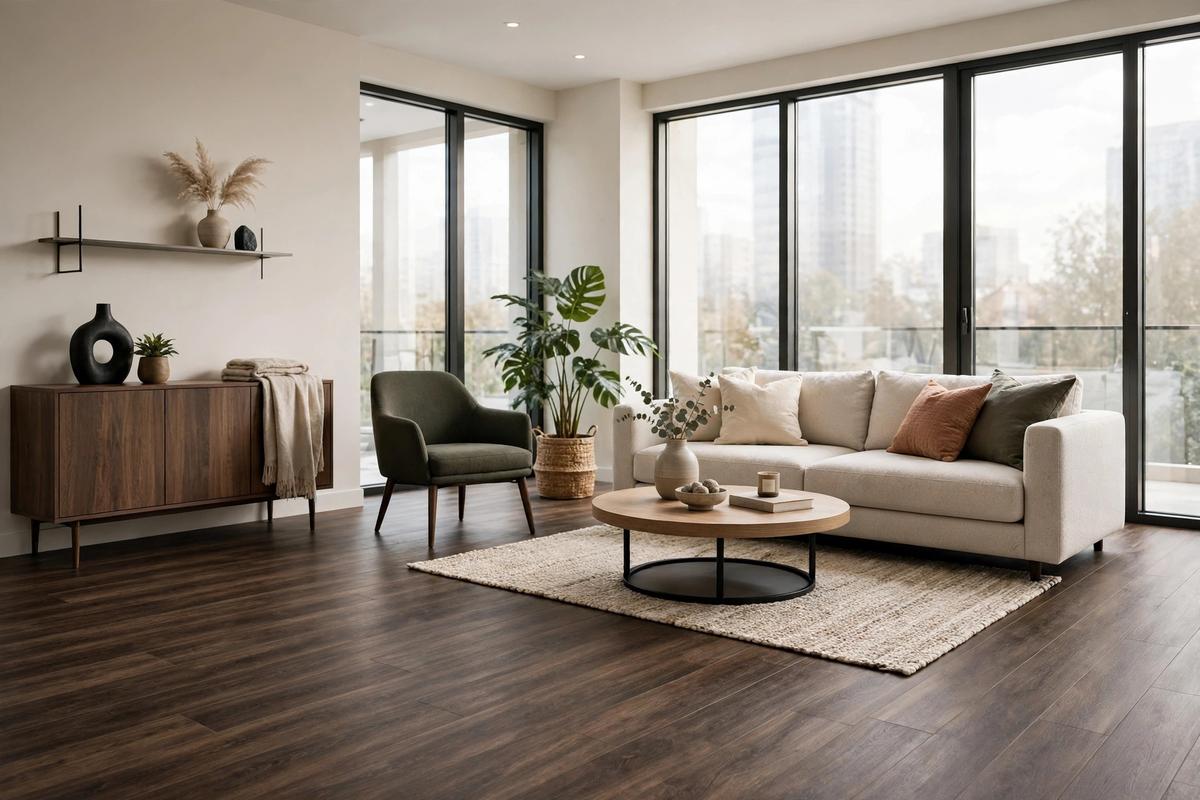
 SPC and LVP are the two vinyl floors most multifamily developers choose between — and they look alike on a sample board. Underfoot, under water and under a hundred tenants, they behave very differently. Choosing the wrong one costs a project in callbacks, replacements and unhappy residents.
Both are vinyl plank floors, but their cores are different: SPC (Stone Plastic Composite) — a rigid core made of limestone powder and stabilisers. The plank is dense, stiff and dimensionally stable; it barely expands or contracts with temperature. LVP (Luxury Vinyl Plank) — a flexible core of PVC. The plank bends, which makes it forgiving on uneven subfloors, but it moves more with temperature and can telegraph subfloor imperfections.
Both wear a printed wood-look layer and a clear wear layer on top. The difference is what is underneath, and that difference decides where each floor belongs.
Both floors are marketed as waterproof, but the claim is not equal: SPC is fully waterproof through the whole plank. The rigid stone-plastic core does not absorb water at all, so spills, pet accidents and a leaking dishwasher will not swell the floor. LVP is water-resistant at the surface. The wear layer sheds water, but the flexible PVC core can absorb moisture over time at joints and edges, and standing water can work its way under the planks.
For kitchens, bathrooms and ground-floor units — the rooms where multifamily water damage happens — SPC is the safer specification.
In a rental unit, the floor takes abuse: furniture dragged across it, dropped pans, high heels, rolling office chairs. Here the rigid core pays off: SPC resists dents and indentation far better than LVP. A heavy refrigerator or a dropped cast-iron pan leaves little or no mark on a 5–6.5 mm SPC plank with a 0.5 mm wear layer. LVP dents more easily. Its flexible core compresses under point loads, and those dents do not spring back.
For high-traffic multifamily units, specify SPC with a 0.5 mm (20 mil) wear layer — the standard for commercial and multifamily use — and expect a longer service life between replacements.
Sound — SPC's dense rigid core plus an attached IXPE underlayment softens footfall and helps the floor assembly meet IIC 50 or higher, important when the unit below is occupied. LVP transmits more impact sound unless a separate acoustic underlayment is added. Comfort — LVP feels slightly softer and warmer underfoot because the core flexes. SPC feels firmer, closer to a real wood or tile floor. Tenants rarely notice the difference after the first week. Installation — SPC's click-lock system installs fast over a flat subfloor, and the rigid planks bridge small imperfections. LVP needs a flatter subfloor — its flexible planks show every bump — and glue-down LVP adds install time and cost.
SPC typically costs a little more per square foot than LVP, but the gap is small and the service life is longer — fewer replacements over the life of the building usually make SPC the cheaper floor overall. Choose SPC for kitchens, bathrooms, ground-floor units, high-traffic common areas and any unit where water, dents or noise matter — which is most of a multifamily building. Choose LVP where a softer feel matters more than dent resistance, or where the subfloor is uneven and the budget does not allow levelling — and accept a shorter replacement cycle.
For most U.S. multifamily projects, the practical answer is SPC throughout the unit, with LVP reserved for low-traffic bedrooms where the budget is tight.
Whichever vinyl floor a project chooses, it should be specified with the cabinets and countertops, not after them. Flooring, cabinets and stone from one supplier arrive matched in tone, on one delivery schedule, and the install crew works from one set of drawings — so the floor meets the cabinet toe-kick cleanly and the island sits on a floor that was planned for it.
Q: Is SPC flooring really better than LVP for multifamily units? A: For most multifamily use, yes — the rigid core is fully waterproof, resists dents better, and performs better acoustically with an attached IXPE underlayment.
Q: Where is LVP still a good choice? A: In low-traffic bedrooms or where a softer feel underfoot is the priority, and where the subfloor is uneven and levelling is not in the budget.
Q: What wear layer should a multifamily project specify? A: 0.5 mm (20 mil) — the standard for multifamily and light commercial traffic. Thinner wear layers wear through faster in rental units.
Q: Does SPC flooring work in kitchens and bathrooms? A: Yes. The rigid SPC core does not absorb water, so it can run through kitchens, bathrooms and living areas with no transitions.
Q: Can SPC flooring, cabinets and countertops come from one supplier? A: Yes. Dawson Stone and Cabinet supplies SPC flooring, kitchen cabinets and quartz and granite countertops as one multifamily package — produced by our Thailand cabinets plant in Nong Yai, Chon Buri, together with our Malaysia cabinet factory in Muar, Johor.
Contact Dawson Stone and Cabinet — one-stop cabinets, countertops and flooring for U.S. multifamily projects. Email: info@thailandcabinetry.com · Phone: +1-657-615-8019 · WhatsApp: +86 130 5543 1394.

Equipo de diseño profesional, con más de 7 años de experiencia promedio en el diseño de viviendas para satisfacer las necesidades de diferentes clientes.


 IPv6 RED SOPORTADA
Links : :
W7 Ceramic Solutions
 en
 es


